
ASCIA Reports
To view ASCIA Submissions go to www.allergy.org.au/ascia-submissions
ASCIA Strategic Plan 2024-2028 and ASCIA Priorities Report 2023 | ASCIA Progress Report - National Allergy Council Shared Care for Allergy Project | ASCIA Progress Report - National Allergy Council Schools and Childcare Project | ASCIA AGM Minutes, Annual Reports, Highlights, Financial Reports | ASCIA Scope of Practice documents | National Allergy Council | ASCIA/NPS Choosing Wisely Australia and RACP Evolve recommendations | Allergy in Australia 2014 | Allergy and Immune Diseases in Australia (AIDA) Report 2013 | ASCIA Education Resources Report 2013 | Economic Impact of Allergies Report 2007
ASCIA Strategic Plan 2024-2028
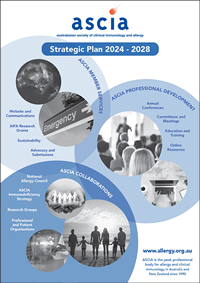 ASCIA's purpose is to advance the science and practice of allergy and clinical immunology. This is achieved by promoting the highest standard of medical practice, training, education and research, to improve the quality of life and health of people with immune system disorders, including allergies, immunodeficiencies and other immune diseases.
 ASCIA Strategic Plan 2024-2028603.26 KB
In recent years ASCIA has worked on developing Strategies for Allergy and Immunodeficiency, which are now being implemented. These collaborations will be a major focus for ASCIA in the next few years.
To ensure that ASCIA can plan for the future, this new ASCIA Strategic Plan has been developed, based on:
- ASCIA’s Purpose, Strategic Areas of Focus and Priorities within these areas
- Findings from the ASCIA Priorities Report 2022-2023
- National Allergy Council projects assigned to ASCIA
- ASCIA Immunodeficiency Strategy
ASCIA Priorities Report 2023
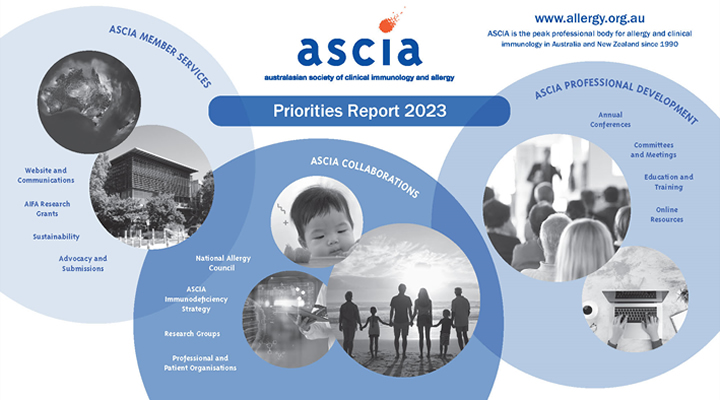 ASCIA works towards achieving its purpose by undertaking a wide range of initiatives that are prioritised and are listed at https://www.allergy.org.au/about-ascia/ascia-initiatives
The ASCIA Priorities Report 2023 is based on the results from the ASCIA Member Survey which was conducted from November 2022 to January 2023. ASCIA undertook to survey the membership to ensure alignment of the ASCIA priorities with member needs. Uptake of the survey was 40% which attests to the enthusiasm and engagement of ASCIA members.
ASCIA Priorities Report 20231.92 MB
ASCIA Progress Report - National Allergy Council Shared Care for Allergy Project
 The latest ASCIA Progress Report - National Allergy Council Shared Care for Allergy Project includes a report based on results from feedback surveys that were conducted in 2022. The optional surveys were included in ASCIA anaphylaxis e-training courses for health professionals, . Survey results will be used to guide course updates, as part of National Allergy Council projects. Further reports will be developed based on mandatory feedback surveys that are being conducted in 2023.
HP Anaphylaxis Report 2022694.21 KB
ASCIA Progress Report - National Allergy Council Schools and Childcare Project
The latest ASCIA Progress Report - National Allergy Council Schools and Childcare Project https://www.allergy.org.au/about-ascia/info-updates/ascia-progress-report-nac-schools-and-cec-project includes reports based on results from feedback surveys that were conducted in 2022. The optional surveys were included in ASCIA anaphylaxis e-training courses for schools and children’s education/care (CEC) services. Survey results will be used to guide course updates, as part of National Allergy Council projects. Further reports will be developed based on mandatory feedback surveys that are being conducted in 2023.
 Schools 2022 Report 629.44 KB
 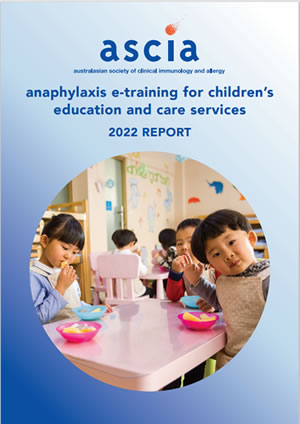 CEC 2022 Report 583.28 KB
ASCIA Immunodeficiency Strategy
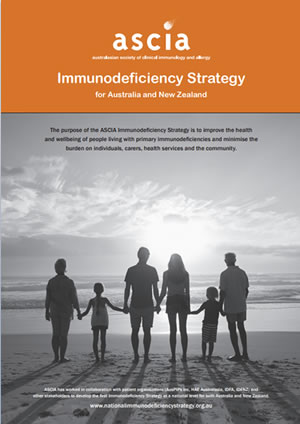 The ASCIA Immunodeficiency Strategy for Australia and New Zealand meeting was held on Friday 28th April, to coincide with World Primary Immunodeficiency Week 2023. The meeting was attended by a range of stakeholders including clinicians (clinical immunologists, specialist nurses and allied health), patient/carer organisations (AusPIPs, IDFA and IDFNZ), and researchers. The meeting was supported by ASCIA and an unrestricted educational grant from CSL Behring. As a result of this meeting a list of proposed prioritised actions was developed which are outlined at https://www.allergy.org.au/about-ascia/info-updates/outcomes-from-ascia-immunodeficiency-strategy-meeting
ASCIA AGM Minutes, Annual Reports, Highlights, Financial Reports
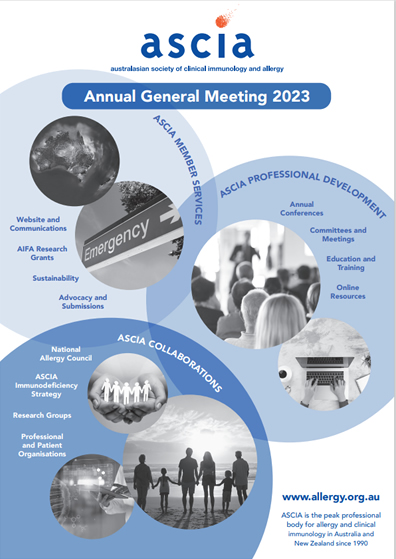
ASCIA Annual General Meeting (AGM) Minutes www.allergy.org.au/members/ascia-agm
ASCIA Annual Reports www.allergy.org.au/members/ascia-annual-reports
ASCIA Annual Highlights www.allergy.org.au/about-ascia/highlights
ASCIA Annual Financial Reports - available on the Australian Charities and Not-for-profits Commission (ACNC) website
ASCIA Scope of Practice documents
Scope of Practice - Allergy Skin Testing in Australia 2018
ASCIA developed this Scope of Practice in response to the Medicare Benefits Schedule (MBS) item number changes implemented by the MBS Review Taskforce, effective 1 November 2018. Whilst these changes were not initiated by ASCIA, the previously proposed item numbers were significantly modified in response to a submission made by ASCIA in July 2017, to ensure patients with complex allergic disease are not disadvantaged.
ASCIA Scope of Practice - Allergy Skin Testing in Australia 2018171.23 KB
Scope of Practice - Specialist Physicians in Immunology and Allergy in Australia 2014
The aim of this Scope of Practice is to outline the range of practice of clinical immunology/allergy specialists in Australia and ensure that patients with allergic and other immune diseases receive the highest standard of care, in line with best clinical practice.
ASCIA Scope of Practice Australia July 2014208.16 KB
National Allergy Council
From 2014 to 2015 ASCIA developed the National Allergy Strategy, in partnership with Allergy & Anaphyalxis Australia (A&AA), which continues to be implemented through the National Allergy Council. The Strategy document is available at https://nationalallergycouncil.org.au/about-us/our-strategy
The National Allergy Council is a partnership between ASCIA and Allergy & Anaphylaxis Australia working in collaboration with other stakeholders.
ASCIA Recommendations - NPS Choosing Wisely Australia and RACP Evolve
ASCIA was the first Specialty Society affiliated with the Royal Australasian College of Physicians (RACP) to be involved in Choosing Wisely Australia, a health profession led initiative faciliated by National Prescribing Service (PBS) MedicineWise and the RACP Evolve program. The ASCIA list of five things that clinicians and consumers should question is available at:
www.choosingwisely.org.au/recommendations/ascia
https://evolve.edu.au/recommendations/ASCIA
For further information about Choosing Wisely Australia go to www.choosingwisely.org.au
For further information about the RACP Evolve program go to https://evolve.edu.au/about
Allergy in Australia 2014
Prior to ASCIA developing a National Allergy Strategy for Australia, the following report was developed in 2014.
Allergy and Immune Diseases in Australia (AIDA) Report 2013
The AIDA report on allergy and other immune diseases (immunodeficiency and autoimmune diseases) was developed in 2013.
Allergy and Immune Diseases in Australia (AIDA) Report 2013720.33 KB
ASCIA Education Resources Report 2013
ASCIA has been developing web based education resources since 1999. In 2013, the ASCIA Education Resouces Report was developed to outline the large range of web based educational resources that are all available at no charge on the ASCIA website.
ASCIA_Education_Report_July_2013483.57 KB
Economic Impact of Allergies Report 2007
The cost of allergies to the Australian economy is estimated to be $7.8 billion, with lost productivity and health system expenditure the major contributing factors. Furthermore, most Australians with allergies face a wait many months to see a specialist, if they can access care at all. These are among key findings in the following report 'Economic Impact of Allergies' by Access Economics that was released by ASCIA in November 2007.
Economic Impact of Allergies Report - 20071.65 MB
Content updated January 2024